In recent years, torrential downpours caused by extreme weather have occurred with alarming frequency. Floods and other disasters happening around the globe, as well as here in Japan, are generally attributed to global warming. The threat posed by these severe rainstorms only escalates year after year. I would like to share a terrifying story tied to one such disaster.
This story dates back about two hundred years to the Edo period, during the Bunsei era. It is said to have taken place in an area formerly known as Bishu, which spans present-day Okayama and Hiroshima prefectures.
One summer, a massive typhoon struck the region. The torrential rain raged for three days and three nights, inflicting catastrophic damage on the area. The river, usually a gentle, quiet stream, transformed completely under the deluge. It turned into a raging muddy torrent that overflowed as if to swallow the entire village whole. As a result, numerous settlements were submerged. Although riverbank reinforcements are advanced nowadays, preventing overflows from light rains, flooding was common up through the mid-Showa period. Records preserved in the local history museum document how easily the river burst its banks after even a brief period of rain. Nestled deep in the mountains, this small village had no major industries to speak of and was relatively poor. The disaster that struck that year plunged the villagers' lives into desperate poverty.
In this village lived a young boy named Bunkichi. He was thirteen or fourteen years old, the eldest son of a poor farming family, with five younger brothers and sisters. Though their home was flooded and their fields suffered some damage from the disaster, Bunkichi’s settlement escaped relatively lightly. On the morning the rain ceased and blue sky returned, Bunkichi joined his parents and grandfather in cleaning up the house.
While hard at work, Bunkichi was visited by three boys from the same settlement. There was Shokichi, a year older than Bunkichi; his younger brother, Masakichi; and Kanta, who was the same age as Bunkichi. They had heard that the small building of Umahiki Shrine upstream had been washed away, and had come to invite Bunkichi to go see it. Ever diligent and earnest, Bunkichi turned down the invitation, citing his household chores. He told them he would join them once his work was done, and reluctantly watched the three walk off.
Around noon, Bunkichi paused his work to eat lunch with his family. As he was resting, slurping cold hiya-mugi noodles prepared by his mother, Kanta arrived, pale and out of breath. Seeing Kanta's frantic state, Bunkichi asked what had happened, but the boy was so panicked he could barely speak. Overhearing the commotion, Bunkichi’s father and grandfather managed to calm Kanta down and piece together his story.
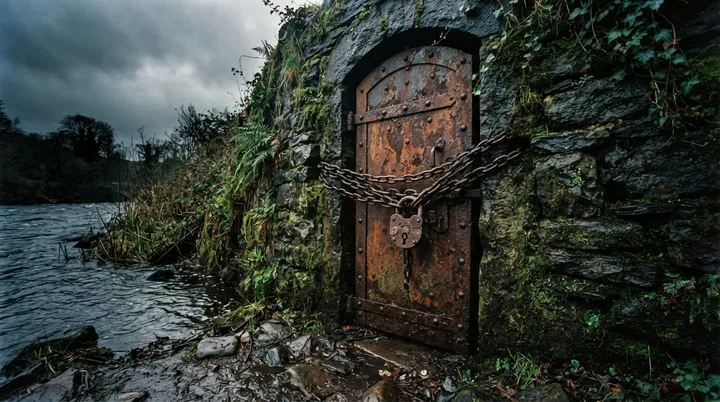
Kanta had set off for Umahiki Shrine with Shokichi and Masakichi. Hearing that the small shrine nestled quietly at the foot of the mountains upstream had been swept away, they went to inspect the damage. Just as rumored, the shrine grounds were in complete ruins, strewn with debris washed down by the storm. The small shrine building had been wiped out without a trace. When the three approached the spot where it had stood, they noticed a large, black iron door set into the foundation. The iron door—evidently an entrance leading underground—was secured with a thick, heavy chain and a large padlock. Intrigued by what lay beyond, they searched the surrounding area for a key. But finding it was no simple task, and they were at a loss.
Just then, a boy they had never seen before called out to them. Introducing himself as Tasuke, he said he had traveled all the way from a settlement on the other side of the mountain path past the shrine. Hearing that the village had suffered severe damage, Tasuke said he had come to check on his relatives. Though the three were wary at first, they quickly hit it off due to being around the same age.
When they explained that they had come to look at the shrine, Tasuke shared a secret. He told them that long ago, a warlord who ruled the region had hidden treasure deep beneath this shrine. He offered to help them break open the padlock. Excited by the idea, the three boys readily accepted his proposal.
They gathered large stones lying nearby and smashed them against the lock over and over. A lock wasn't something children could break easily. After struggling against it for nearly two hours, they finally succeeded in shattering it. Removing the padlock, they uncoiled the dull, heavy chain from the iron door. The double iron doors were extremely heavy, but combining their strength, the four boys managed to pull them open.
Beyond the door lay a narrow flight of stone steps, plunging so deep that the sunlight couldn't reach the bottom. Uncertain of how deep the cavern was and overwhelmed by the eerie, bottomless atmosphere, the three boys hesitated to step inside. Only Tasuke pushed them forward. Taking the lead as the eldest, Shokichi announced he would go first. Masakichi followed, then Kanta, with Tasuke bringing up the rear.
First Shokichi went down, followed by Masakichi. Just as Kanta stepped down one stair, he noticed Tasuke, who was supposed to be behind him, was nowhere to be seen. He called out to Shokichi at the front, but Shokichi brushed it off, saying Tasuke had probably chickened out and hidden somewhere. Kanta scanned the area for a moment, but Tasuke had vanished. Just as Kanta prepared to move forward anyway, he heard Shokichi’s voice again. Shokichi claimed he had found a box deeper down in the hole.
Kanta stepped back out of the hole and waited for the two to return. After a brief wait, Masakichi emerged first, followed by Shokichi, who was cradling a black box about a foot long. The top of the box was sealed with a red paper talisman. Though it felt sinister, they believed inside lay the treasure hidden by the warlord.
With half his body still in the opening, Shokichi set the box on the ground. He roughly tore off the red talisman and opened the lid, revealing a black urn inside. The urn was also sealed with a red paper talisman. Something dry seemed to be inside, making a rattling sound when shaken. Expecting gold coins, the three were slightly disappointed by the sound, but having gone through the trouble of breaking the lock, they clung to a faint ray of hope.
Cruelly, that hope was crushed. The moment Shokichi broke the seal on the urn, a black mist billowed out. It swirled up like thick smoke, spreading rapidly across the area. The shrine grounds, which had been clear and sunny moments before, suddenly turned as dark as twilight. Moreover, the cries of countless infants and young children began echoing from every corner of the grounds. A violent wind started to howl.
Terrified by the unnatural atmosphere, the three scrambled to escape. Just as Kanta and Masakichi turned to sprint toward the torii gate at the shrine's entrance, Shokichi, still half-submerged in the stone stair opening, let out a bloodcurdling scream. Looking back, Kanta saw countless black figures—shadows resembling small infants—clinging to Shokichi. Reaching out to grab Shokichi, who cried out for Tasuke, Masakichi tried desperately to drag his brother up from the stairs. But the black shadows swarmed Masakichi as well. Helpless, both boys were dragged down into the murky shadows below the stone steps. Kanta stood frozen on the spot, unable to do a thing. Before Kanta's eyes, the two figures grew smaller and smaller into the depths of the hole, finally vanishing... leaving behind a horrifying death scream.
Hearing that death scream snapped Kanta out of his paralysis, bringing him back to reality. Realizing he would suffer the same fate if he stayed, he darted through the squirming shadows surrounding him and fled out of the shrine grounds.
Sobbing hysterically, Kanta finished telling Bunkichi and his family what had happened. As Bunkichi listened in half-disbelief, he noticed his father and grandfather had turned deathly pale. His grandfather spoke: “There is no settlement beyond Umahiki Shrine. That village died out long ago—it's been abandoned for decades.” Hearing this, Kanta was left speechless. Bunkichi’s grandfather sternly ordered his father to rally the men, and the father rushed out of the house. Grandfather then turned to Kanta and Bunkichi.
“I hate to say something so cruel, but Shokichi and his brother are almost certainly beyond saving.”
In less than an hour, the men of the settlement assembled and headed toward the shrine. Bunkichi’s grandfather said he was going to the village headman's house, adding that he would walk Kanta home on the way to explain everything to his family before leaving.
Bunkichi was left behind, but not before his grandfather warned him, “Under no circumstances are you to go near that shrine.” Even with the warning, curiosity got the better of him, so he climbed a tall tree nearby to look toward the shrine. Surprisingly, dark, heavy clouds hung over the area directly above the shrine.
As dusk approached, Bunkichi's father returned from the shrine, and the whole family went to the village headman's house together. It turned out the headman had gathered the villagers to explain what was happening. A large crowd of residents had flooded the headman’s house, along with about ten Shinto priests who appeared to be high-ranking officiants. Once everyone assembled, the headman spoke, saying he would explain what had occurred and what was about to happen.
Then, one of the Shinto priests stepped forward. He looked to be the oldest among them, yet radiated the highest authority. Introducing himself as Izumi, he said he was the chief priest of a prestigious shrine. He then began explaining the events.
This village had long been a poor land where villagers scraped by a meager living. On the barren soil, crops barely grew, and people struggled just to feed themselves. Living in constant fear of famine, the practice of infanticide—mabiki—eventually became widespread. It was not uncommon to kill newborn children or abort pregnancies. That was not all. As children grew, only the eldest son was kept to carry on the family name; younger brothers and sisters were often sold to child traffickers. Girls, in particular, were actively sold off because buyers could be found.
Yet the fate of the sold children was tragic. Many parents came to learn of the tragic, inhumane deaths their children suffered. Even so, lacking the means to raise them, parents had no choice but to sell their children in tears. Many parents would see their children off at Umahiki Shrine one last time. For this reason, Umahiki Shrine came to be known as Enkiri Shrine (the Shrine of Severed Ties), and the mountain was called Mount Enkiri. (*The path leading to the settlement where the boy Tasuke claimed to come from is said to lie further up this mountain, separate from the road to the town.*)
Eventually, mothers who had killed their babies and parents who had sold their children began enshrining their infants' umbilical cords at the shrine as a last attempt to pray for their souls. But it did not stop there. Plagued by unbearable guilt, mother after mother took her own life to follow her deceased children. As these tragedies accumulated, the shrine came to be known as both Enkiri Shrine and Mabiki Shrine. (Originally, it was called Umahiki Shrine after a festival where horses were led through to pray for health and a bountiful harvest.)
Following a series of such tragedies, a devastating famine struck the village one year. Not only that, a deadly plague swept through, wrapping the entire village in a foul, cursed miasma. Unable to handle it alone, the priest at Umahiki Shrine called upon nearby shrines for aid. When the assembled priests investigated the cause, they discovered that the enshrined umbilical cords had transformed into cursed relics, casting a blight over the entire village. After chanting prayers and performing purifications for three days and three nights, the priests dismantled the shrine building, buried the cursed relics deep underground, and agreed to manage the site together. They decreed that the seal would need to be renewed every fifty years—and this year was that fifty-year mark.
The chief priest concluded his explanation by saying that while this incident was triggered by children who were deceived by a spirit, the children were not to blame. The true root lay in the village's history and the culture of infanticide that had taken root in this land. (During Bunkichi’s time, infanticide was no longer practiced, poor as they were.)
He then stated that over the next three days and three nights, they would exorcise the vengeful spirits. He strongly urged the villagers to strictly obey three rules:
One, never approach the shrine. Two, never leave your house after sunset. Three, never answer if someone calls your name.
He instructed them to follow these rules without fail, adding that no one should leave their home unless absolutely necessary.
From that day on, the purification rituals took place over three days and nights. Torches burned throughout the village as priests took turns patrolling the streets, continuously chanting prayers. Villagers could hear infants crying, young children calling for their parents, and voices that sounded like mothers calling for their children echoing from all directions.
According to Bunkichi's own account, he heard a voice calling his name from outside his tightly shuttered home. The voice pounding on the shutters and calling his name sounded familiar—it belonged to the Shokichi brothers. Remembering the chief priest’s warning, he never answered their calls. When the three days and nights of purification ended, the urn containing the umbilical cords was re-buried deep beneath the rebuilt shrine. It was then that the horrific remains of the Shokichi brothers were uncovered.
Today, depopulation has turned this village into a vanishing settlement. This tragic tale has been passed down in this nature-rich village destined to eventually fade away. The storyteller who shared this tale with us is Mr. Nakamura, whose family has lived here for generations. Mr. Nakamura is, in fact, a direct descendant of Bunkichi.
When Mr. Nakamura was an elementary school student, the river flooded once again, and the shrine was engulfed by muddy waters. At that time, an absolute decree was issued by the adults of the settlement: "Do not go near it under any circumstances." He didn't learn the truth behind that order until he reached adulthood, but the legend lives on in the village today.
“I’ve never checked whether something like that is actually hidden beneath the shrine, nor have I heard anyone else doing so. It might just be a story made up by adults to keep children from getting into trouble. But you know, it’s a fact that long ago, there was a tragic era when terrible things like infanticide were accepted. That’s precisely why we must be grateful to live peaceful lives today. Eventually, this village will disappear. Until that day comes, I believe we have a duty to pass this story down. I believe that is our way of comforting those lost souls.”
As Mr. Nakamura spoke, his gaze rested upon the small shrine standing quietly in the distance.